Saturday, September 8, 2018

Sniper Ghost Warrior 3


This game got savaged by critics and players alike when it was released for being too much like a discount Far Cry game, despite being an indie game from a small company in Eastern Europe. The comparisons to Far Cry are fairly apt - the game features a small open world for the player to walk, drive, or zipline through, there are outposts to clear and sidequests to engage in, and a small variety of collectibles to gather. Sniper Ghost Warrior 3 lacks the more unique and fun features of Far Cry, though, such as animal attacks, hunting, flight, weapon variety, customization, the scale of the world,  and a good story. What sets Sniper apart, however, is the gunplay mechanics.

The conceit of Sniper Ghost Warrior 3 is that it has realistic bullet physics modeled into its weapons, and the missions focus on stealth sniping missions where the player must travel to a vantage point and shoot at his targets from long range. Had the game kept this focus and not forced an open world into its design, it probably could have avoided all the negative comparisons.

In Far Cry, the silenced sniper rifle is one of the harder weapons to obtain because it is almost overpowered, but in Sniper Ghost Warrior it is your primary weapon. Sniper Ghost Warrior tries to balance the effectiveness of this weapon by placing a large number of counter snipers and mortars on the enemy posts, and by balancing the AI around hiding behind cover and spotting you from afar, which in theory should force the player off their sniper perch (but in practice never really works right).


But the mechanic that really makes sniping far more fun in Sniper Ghost Warrior is that the bullet is modeled as an actual projectile which realistically travels through the air, so the player must account for the travel time and lead his targets. Wind resistance, direction, and bullet drop are also taken into account, and the best way to use this mechanic is to turn the "aim indicator" off, since it shows you exactly where the bullet will land, thus negating the whole point of judging those variables for yourself.  If you make a wrong judgement and miss, the report of your bullet will alert your target to your presence, which I still find exciting even if I missed. To me, it is far more satisfying to see the bullet actually fly to my target rather than instantly hitting them, and I'm not talking about the slow motion killcam, which is actually less satisfying to me than just seeing my target drop from a well aimed shot.

In the Far Cry series, all the bullets are hitscan, and I don't think they're even affected by gravity, which means that they're essentially the Railgun from Quake, and they're serviceable in an action context but lack the complexity and thrill of sniping from Sniper Ghost Warrior.
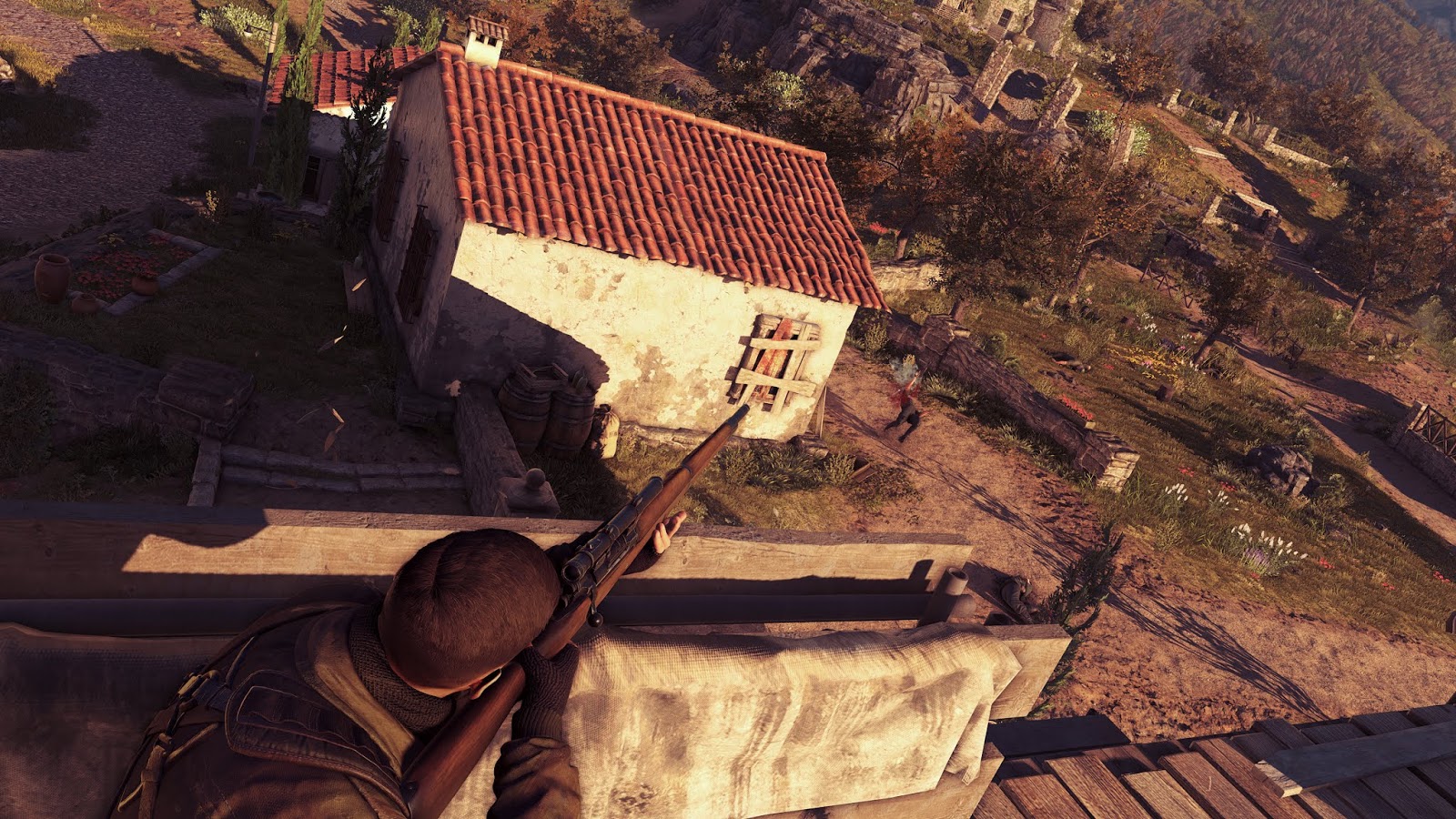

There is another sniper game series that opened to much better reviews and always gets compared more favorably than the Ghost Warrior series, and that is Sniper Elite. Sniper Elite 4 also has large levels that function as pseudo open worlds, a stress on stealth and long range gameplay, and a calculation of wind, distance and bullet drop in its sniping mechanics. One thing it does far and away better are the many different ways you can kill your targets - you can use bullets to blow holes in gas tanks, engines, tires, exposed grenades and more, leading to spectacular explosions, you can drop heavy objects onto your opponents, trick them, bait them, and do so much more.


Despite all this, I consider its actual shooting mechanics to be lesser than Sniper Ghost Warrior's, because the weapons in Sniper Elite are all hitscan. What this means is that even though you account for distance, wind direction and bullet drop, none of it really matters because all it does is make you adjust your aim a little on a 2D plane, as in simply choosing a different (x,y) coordinate on which to place your crosshair, rather than meaningfully visualizing the path of your bullet.  Sniper Elite's method of balancing this is to make your bullet slightly inaccurate unless you hold your breath for the accuracy to gradually increase.  Unfortunately it also has an aim indicator, which I always turn off.

Also, I have a few random complaints against Sniper Elite, such as its 3rd person perspective in which the character blocks your view of the weapon, and the fact that cycling the bolt and reloading the magazine do not cause the player to scope out. Where Sniper Ghost Warrior plays like a discount Far Cry, Sniper Elite plays like a discount Metal Gear Solid V: The Phantom Pain. The latter game actually does a lot of things right that Sniper Elite does wrong. Metal Gear gives you nonlethal options to confront a level and there is way more interaction with guards in terms of interrogations, holdups, and combat. "Aiming down sights" in MGS is required since without it the player character will use his fists to strike or throw an opponent, in Sniper Elite he is always holding his weapon so why does he need to go into a special aim mode to fire? MGS also gives a first person view option which Sniper Elite lacks except technically on rifle scopes.  Metal Gear also pseudo models the necessity to lead your targets by changing the calculations on bullet hit for moving targets, which Sniper Elite doesn't implement. Also there are weirder, more fun weapons in Metal Gear and the standard tranquilizer pistol is an actual projectile weapon.


The only other game series I know of with projectile sniper weapons is the Battlefield series. In fact it was my experience sniping in Battlefield 1 that compelled me to find another game with deep sniping mechanics, as Battlefield is multiplayer only and as such has a shelf life and subjects you to other problems if you just want to enjoy the game, like network lag, finding a server, finding a good team, etc.

Sniper Ghost Warrior 3 is an indie game masquerading around as a triple A studio title, and that becomes noticeable once you see all the rough spots just underneath the surface. I actually commend the development team for taking on such ambitions and aiming for the leaders in the industry, rather than being an intentionally budget title like most indie games. The open world is the critical flaw and I feel that if they had focused on making a pure sniper sim the game would have been better received. The development team did talk of their passion for emergent gameplay, and the earlier Sniper Ghost Warrior games were criticized for their restrictive linearity, so I see why they experimented in this direction. While many better games exist and do more than what Sniper Ghost Warrior 3 does, it does one thing that they do not do and does the pure sniping much better than its competitors.

*as an aside, I don't know if the pistols and assault rifles in Sniper Ghost Warrior 3 are hitscan or projectiles so fast that they seem hitscan. The enemies don't move or strafe fast enough for leading them to become a necessity, and with realistic bullet velocities its hard to discern over short ranges anyway. For the sniper rifles it is easy to see the bullet travel with a long range scope, however the same is not apparent on unscoped or iron sight pistols, rifles and shotguns.

*the best difficulty to play Sniper Ghost Warrior 3 on is the second-hardest. Realistic difficulty makes most weapons one shot to kill, which forces players to stay hidden in stealth longer. While that might be more enjoyable to sniping purists, I find that it just drags out the game and throws weapon balance right out the window, thus making little distinction between the damage your primary sniper rifle does and what a pistol does. In fact, in realistic mode I would simply mark my targets then take them out with a silenced pistol instead, which you can't do on on the second-hardest difficulty since the pistol will take 3 bullets to kill and the first hit will alert the enemy to your presence.

Saturday, September 1, 2018

Should you buy Star Wars: Battlefront?

Honestly, they're both pretty thin on content, with casual gameplay that's a stripped down version of Battlefield's gunplay. They're both heavily online multiplayer focused, yet the population for both is quite small and about the same for both. In terms of offline play, Battlefront 1 has the better content, since its largest game mode, Walker Assault is included in the skirmish mode, while the Arcade mode of Battlefront 2 only has two game types - a team deathmatch equivalent and a horde mode/survival equivalent. The 'mission' game types of Battlefront 1 also give you different experiences such as driving a speeder bike or flying a snow speeder, which is not available in Battlefront 2's offline modes. While Battlefront 2 has an offline story campaign, its utterly boring and forgettable, short and offers no replay value.

The only reason to get either is if you love the Star Wars universe and can't get enough, in which case Battlefront 1 has more weapons, power ups, better game modes and heroes, while Battlefront 2 has better space and vehicle modes.

Due to fan backlash and overrall poor reception, I predict both games will hit bargain price very quickly, especially after Battlefront 2's support cycle ends.

Star Wars: Battlefront (2015) is better than Star Wars: Battlefront II (2017)

When Battlefront 1 was released it was rightly criticized for its thin content and casual gameplay. However after all the DLC released and a few free content patches were given, it now has more than enough content to warrant a full price purchase. It's an exploitative business practice to rely on DLC to make your game fully featured by charging double, but EA makes the fictitious Galactic Empire look like care bears by comparison. Also all the content can be bought in the Ultimate Edition for a reduced price.

Battlefront II promised to make up for all the errors of the original game by distributing all DLC for free, having more content at launch, and having deeper gameplay, but now almost a year after launch we have learned that all those promises were false, and Battlefront 2 is worse in every way than it's predecessor.

To start with, while Battlefront 2 has more maps than Battlefront 1, several DLC maps of Battlefront  2 are just ports of Battlefront 1 maps. Honestly this isn't as big of a deal for me as I generally find that players online gravitate to one or two maps that they really like, and just play them over and over, such as de_dust and Italy back during the CS beta days.

A major issue however, is that Battlefront II has less weapons to use. Related to that is that the class system from Battlefront II is actually worse than the star card system from Battlefront 1. And the third related issue is that Battlefront II still uses star cards despite also having a class system.

The reason this is a problem is because it gates content away from the player. Nominally, this is to balance the gameplay better, however the weapons and abilities can still be balanced without locking them behind specific classes. Battlefront's implementation of classes also makes the gameplay inconsistent, as now your weapon's effectiveness varies depending on the health and resistance of your opponent.* It also killed the in game customization, since all classes need to remain visually recognizable for players to gauge their opponents in game.

Admittedly, the jump pack broke the balance of Battlefront 1 and became a "must pick" star card for every player, so Battlefront 2 made a rational change in locking it to an elite class, but that's really the only positive change.

The Star Card system was never as good as Battlefield's equipment system or Call of Duty's loadouts, but in Battlefront 1 it still potentially allowed you the freedom to experiment and choose what you wanted to complement a play style. In Battlefront 2 the star cards do not allow you to customize and experiment, and you are locked to a small selection of Star Cards per class and the majority of them are just direct upgrades to your existing abilities. A great deal of depth is lost and eventually you just end up playing the same class the same way.

There are only four weapons per class in Battlefront 2, and the default weapon just changes appearance depending on which faction you are playing. This is a straight downgrade from Battlefront 1 where every weapon was available to the player, and all had their own unique stats.

And as a Star Wars nerd, I fault Battlefront II for including the sequel trilogy and spinoffs, and now the Clone Wars. Battlefront 1 stuck to the universe of the original trilogy, where everything is iconic, and not the other movies, where everything is a pale copycat.  Battlefront 1 does have a map set on Jakku, a planet introduced in the 7th film, and it makes my point for me - there is nothing on this map that makes it distinct from Tattoine, apart from brighter colored sand and a fallen Star Destroyer in the distance. The final DLC adds content from the spinoff movie Rogue One, and the forgettable quality of that also proves my point.

And the most important reason why Battlefront 1 is just better, is that the gunplay in Battlefront 2 is just worse. The first Battlefront was heavily criticized for extremely casual gameplay, such as low spread, little to no recoil, no difference between firing "from the hip" and zoom in aiming. The people complaining about that are idiots. All of those are very good things, and everyone agrees, even the detractors, that accurate led to a faster, more aggressive playstyle. The community was expecting something slower like the Battlefield, which is more about tactical positioning than it is about aiming and tracking your opponents. Battlefront also has more movement options with the addition of the dodge roll and yes, the jumppack, which leads to more dynamic gameplay and discourages camping.

Battlefront 2 brought in the mechanics of military shooters, much to its own detriment. Reloading/"cooling" became a central aspect of the metagame, the weapons were made less accurate in "hip fire" mode but thankfully not to the severe levels in Call of Duty or Battlefield, and the time to kill on weapons was shortened. This coupled with the lack of variety in weapons per class, the balance problems between each class, and the awful star card system lead to gameplay that is much less about player skill than it is about the setup of the player and random luck.

What Battlefront 2 should have done instead is either copy the loadout system wholesale from the Battlefield or Call of Duty series, or stick to the rigid class system of Pandemic's original Battlefront series, where there was no customization in class at all but there were something like 6 classes per faction and extra unlockable classes.

And finally, one idea that Battlefront 2 had that was technically better than Battlefront 1, but failed in execution was the removal of the token pick ups. Battlefront 1 had tokens scattered throughout the map which would give players a random extra ability or let them spawn in as a hero or vehicle, and Battlefront 2 removed this in favor of a point system. The system in Battlefront 1 was random and frustrating, and all the hero and vehicle pickups would be camped by players who wanted to lock them down, so the battle point system of Battlefront 2 sounds better on paper, however it is hobbled by the need to unlock heroes and vehicles outside the match before playing, and the number restriction on vehicles, which means players that are built to farm battle points will lock those down before other players. Also this system means that the fourth ability slot is lost.

Battlefront 2 did only one thing better than Battlefront 1, and that is the starfighter gameplay. However, the vehicles actually handle exactly the same as the first game, there is just the option to manually control your roll. Still, it is technically a straight improvement over Battlefront 1 and the added UI elements like the missile lock notification and aim indicator, and the removal of auto-aim fire, greatly benefit the starfighter gameplay.

In conclusion, Battlefront 2 made a lot of promises to improve Battlefront 1, and came up short. The only ones it did deliver on were a larger number of maps and vehicles, however the gameplay is still bland and unexciting, the star card system actually got worse, and the new class system actually created more problems and removed the few good things from the first game. I hope the fan backlash from two successive failures from EA discourage them from making a Battlefront 3, but it is still sad to see one of my favorite shooter series and fictional universe lose such potential.

Battlefront 1 has more weapons, larger star card variety, better balance (but you still must pick the jetpack on any loadout), better game modes and faster gameplay. It also has a litany of problems, however those are not addressed in Battlefront 2 at all. Battlefront 1 now sells in the Ultimate Edition, which bundles in all the DLC and makes it a much more compelling purchase than Battlefront 2.


*This is also a criticism levied against Quake Champions, but the "champions" of Quake champions do not lock weapons to a specific hero, and while health, armor and speed vary between champions, the added active and passive abilities give players more tools to make their character more effective, even if the weapons take longer to kill your opponent if he has a higher health and armor limit. Admittedly, it's not perfect, Quake 3 was as close to perfect in it's way, but if you want that experience then play with active and passive abilities turned off, and force Ranger as the only playable champion.

Friday, August 10, 2018

Anno Domini and Common Era

When I was growing up in the 90's there was a push among academia to replace the occurrence of AD and BC to keep dates in scholarly works with CE and BCE. The reasoning for the is that "Anno Domini" is Latin for "Year of our Lord" and refers specifically to the era after Christ's birth, and since not everyone accepts the Dominion of the God of Christ, a more religiously neutral term is necessary.

But who are these people that don't accept the Dominion of God, and why do they want to erase God's remembrance from the calendar?

Anno Domini was only used in the first place because all previous reckonings of time used the name of the Roman Emperors to categorize eras, so for example the first year of the reign of the Emperor Diocletian would be 1 Anno Diocletian. A Christian monk didn't like that, especially since Diocletian was a notorious persecutor of Christians, so he erased the name of Diocletian by counting from the year of Christ's birth, not the death of the Roman Emperor, and since the Roman Catholic Church was the guardian of Western knowledge for several hundred years, that is what we've used since.

Why did we suddenly decide to change this in the late 20th century?

"We" didn't decide anything. A growing demographic in academia wanted to change this convention because they had never accepted Christ and had been enjoying unprecedented acceptance and influence in the Western world, and so wanted to change whatever they could to suit themselves.  It wasn't Muslims, because every Islamic scholarly work begins and ends with the name of Allah, and every Muslim can't help but tell you "Insha Allah" for something he never plans to do anyway, and Islam has its own lunar calendar anyway. I doubt Muslims ever wanted to make a term religiously neutral.

It wasn't even atheists, because their voices were always more scattered and atheists tend to create replacement religions, they they just don't call religions.

No, it was the growing influence of the Jewish bloc in Western academia. They are demographically numerous, organized, have their own scholarly traditions, and have a hatred of Christianity that most Muslims do not willfully comprehend. The erasure of Jesus' legacy, and his followers has been an agenda of organized Judaism basically since the crucifixion, or wherever and whenever his teachings became more popular than Talmudic teachings. To the Jewish people, Jewish law supersedes all other law, even that of the state or nation.

And replacing "Anno Domini" with "Common Era" was a targeted campaign in academia that played on the sympathies of Protestants and people who didn't want to be "too religious", and used as its unwitting henchmen atheists, agnostics, and anyone who ascribed to an alternate religion like Wicca, earth worship, Freemasonry, and whatever else.

Sadly, even Muslims were duped, and willingly went along with this plan. They thought it made things more "fair" for their religion of Islam, when in reality it does anything but.  Muslims in the West play the dupe for every new age, anti-religious movement because they are told that it will help represent Islam, when all it actually does is tear down the structures of Christianity, and Muslims are more than willing to be the attack dog for these pernicious causes.

Does CE and BCE really replace the remembrance of Christ? After all the dates are the same, you just replace the post script.

In that case, why bother rewording at all? The birth of Christ, or the first year of Dominion, is an actual point in time. We can calculate any date from that date if we use it as a point of reference, just as if we can use the date of the ascension of a Roman Emperor, or anything else, but "Common Era" is not a definite point of time, you cannot travel to any one point in time and say "this is the beginning of the common era, and a second before this is before the common era". "Common Era", as a means of measuring time, is worthless.

And, as an aside, this is how I know it's a conspiracy, because like all late 20th century left wing a Jewish conspiracies, it replaces something real and quantifiable with something meaningless and nebulous, like Feminism and the Patriarchy, like racism, like antisemitism, like homophobia.

It is the duty of anyone intellectually honest, rigorous and scientific to reject these shallow replacements and hold onto the truth, no matter how ancient it's discovery might be. Yet sadly, those who should be the guardians of truth in academia are doing the complete opposite, and are embracing meaningless new age fads.

Ranking the Assassin's Creed games

AC1 is the template for all the other AC games, but is itself a deeply uneven game with good ideas but mixed execution, and a lot of repetitive gameplay.

AC2 is best AC

AC:Brotherhood is an expansion pack for AC2

AC:Revelations is an expansion pack for AC2, but by this point the formula has gotten stale.

I did not play AC3, but I haven't heard  good things about it.

AC4: Black Flag is an amazing pirate simulator, but the time spent not doing pirate shit but assassin shit instead sucks.

AC:Unity is the most underrated AC game with the most gameplay content in the series, but is marred by many technical issues.

I did not play AC:Syndicate

AC: Origins is no longer an AC game, but is Far Cry set in Egypt during Classical Antiquity.

Friday, June 29, 2018

Assassin's Creed Unity

This game got a bad rap on release, due to numerous bugs and issues at launch. Also, it was the unlucky target for general Ubisoft hate, as in 2014 Ubisoft had been running a very exploitive business model and were pushing out lower quality products yearly that relied on brand name to sell. Basically, they were a nascent EA or Activision.  Also, the "bull-shot", or screenshot faked to look better than what's actually in the game, became an art form pioneered by Ubisoft, and they spent lavishly to hype up the game only to release a disappointing product at the end.

Assassin's Creed: Unity is a victim of all these problems, yet underneath it all is a very decent game.

I've been a fan of the Assassin's Creed series since its inception, I still consider the first game as an open world Prince of Persia: The Two Thrones, however Assassin's Creed 2 cemented my love for the series. Unity isn't quite as good as 2 but it is a worthy runner up after the boring rehashes after Brotherhood.

As an aside, Black Flag is the best pirate simulator made to date, but the actual Assassin's Creed part of the game - open world cities, social stealth, and free running assassinations - are straight rehashes of its predecessors and the worst parts of the game. After you get the Jackdaw pirate ship, you'll never want to touch a main story mission again.

Assassin's Creed: Unity is an iterative reinvention of the franchise's gameplay. The climbing and parkour system got reworked, as did the combat, stealth system, and social blending.

The combat is harder than previous games - the enemies are far more aggressive and will attack you with both swords and firearms, you can die easily against large groups and now you have to consider the specific strengths and weaknesses of the enemy type you are fighting. You cannot counter-kill everyone with a press of a button, but parrying your way to victory is still a viable tactic.

The parkour rework just sucks. They added 3 free run options - run straight (hold right trigger), run up (right trigger + x) run down (right trigger + o). There are special input commands for entering windows, avoiding obstacles, leaping off of walls or up them. Unfortunately its way too complicated and controls terribly. Most of the time the character does not do what you want him to do and the ledge and wall detection is as finicky as ever. Free running seems like it has a mind of its own and feels like controlling a runaway train.

The stealth system got reworked with a new cover mechanic, and the crouch walk/duck walk that I detest in all stealth games. Crouching down to waist level magically makes you undetectable to people when they would have seen you standing straight up. This is a rant for another time. The cover system lets you duck behind objects or around corners in order to ambush a target.  As with all of Unity's new systems, the cover system is really finicky in how it magnetizes the character to cover, how you can come out of it, and who can detect you.

The Achilles heel of all of Unity's new systems are the controls - they are clunky, complicated, and have lagged responses.  The team at Ubisoft really harped on all the new tech they created for AC:Unity, and it shows that they did create a lot of new tech, however it all could have benefited from a lot more polish, bug fixes and time in development. These are really good ideas - I hate crouch walking but I think covering behind items and assassinations from cover really enhance the realism  and tactical nature of stealth. The Uncharted series actually perfected the controls for this system and it launched a wave of copycats. I would have loved to see this system in the open world environment of Assassin's Creed but unfortunately the developers rushed to release this product before it was finished.

The crowds, on the other hand, are the highlight of this game. This feature got some of the most criticism on release - areas with large crowds caused massive game slowdown, frame rate drops and ugly object pop in. As a result of having so many actors on screen, the texture resolution on NPC characters had to be dialed way down, and leads to the clothing of 18th century France, some of the most lavish in human history, looking kind of bland and ugly up close.

However, nothing compares to the experience of muscling your way through a crowd, sneaking past the guards, climbing into and sneaking through a Parisian stronghold to assassinate the target inside. I feel like this is the experience that the Assassin's Creed series had been building towards ever since the release of the first game, but had always been held back by technology. Unity may be the closest we ever come to seeing this vision fulfilled, as the critical backlash of this game meant that in all subsequent titles, the large crowds have been removed. Even in Origins, Assassin's Creed's latest and greatest release, there are very few non player characters on screen at a time, no large crowds and the civilians barely do anything more than walking around.

And this is a shame, because the Assassin's Creed series has never had much interactivity with the civilians. It's not an RPG like the Witcher or Oblivion, where every NPC can be interacted with and may draw you into a new quest or mini game. It's not a Thief game where every NPC is a potential target to be robbed. The most you can do in an Assassin's Creed game is use groups of 3 or more NPCs to hide from guards. At least filling the world with large crowds and large numbers of NPCs on the streets made the Paris of AC: Unity seem populated and "realistic", as opposed to the small, nearly abandoned towns in EVERY other game.

The reception of this game prompted Ubisoft to strip everything down for the next, yearly cash grab release, and when that game tanked as well they put their next game on hold for a year, finally giving it the development time it needed to be acceptably polished on release, but every innovation and rework done for Unity was thrown out wholesale and replaced with a new system.

Assassin's Creed: Origins had a completely new combat system inspired by Dark Souls, the cover system was completely gone and the stealth system was stripped down to crouch walking only, the NPC crowds were completely gone, but at least now you could get side quests from special NPCs. The game released to rave reviews and revitalized interest in the franchise, but I feel that makes Unity all the more unique for having its own vision and a gameplay experience you can't get in any other game.

I feel that if you can get past the flaws of Assassin's Creed: Unity, both technically and in some gameplay decisions, there is a lot to enjoy and a very immersive, engrossing game underneath. I find precious few people defending this game other than some dedicated fans, since most just played it briefly on release and then forgot about it in favor of the next yearly release. I bought this game to sate my hunger for an Assassin's Creed 2 like experience, and while Unity will never be as good as that game it is still better than the rehashed copy games that the franchise had become and like all the good Assassin's Creed games, will suck you in and refuse to let you out from its world.

Tuesday, June 5, 2018

Quake 3 is perfect

/it doesn't matter what mood I'm in: whether I want to take it easy and meander around for some slow kills, or play an objective based game mode like Capture the Flag, or go all out racing at the speed of light with my reflexes running in split seconds going for kill after kill, Quake 3 delivers.

In Quake you cannot shoot at where the enemy is, you must aim to where they will move to. This goes for the hitscan weapons as well, because the character speed is so high that prediction is the only reliable way to hit your target. 

Though its lack of a dedicated single player campaign was unusual in 1999, now its more or less industry standard, and Quake actually has more solo player content than most games due to the inclusion of bots and campaign matches.

When I ran 5e, I felt like I was fighting the system itself in order to run any kind of campaign through it, as characters had too many spec...