When I was growing up in the 90's there was a push among academia to replace the occurrence of AD and BC to keep dates in scholarly works with CE and BCE. The reasoning for the is that "Anno Domini" is Latin for "Year of our Lord" and refers specifically to the era after Christ's birth, and since not everyone accepts the Dominion of the God of Christ, a more religiously neutral term is necessary.
But who are these people that don't accept the Dominion of God, and why do they want to erase God's remembrance from the calendar?
Anno Domini was only used in the first place because all previous reckonings of time used the name of the Roman Emperors to categorize eras, so for example the first year of the reign of the Emperor Diocletian would be 1 Anno Diocletian. A Christian monk didn't like that, especially since Diocletian was a notorious persecutor of Christians, so he erased the name of Diocletian by counting from the year of Christ's birth, not the death of the Roman Emperor, and since the Roman Catholic Church was the guardian of Western knowledge for several hundred years, that is what we've used since.
Why did we suddenly decide to change this in the late 20th century?
"We" didn't decide anything. A growing demographic in academia wanted to change this convention because they had never accepted Christ and had been enjoying unprecedented acceptance and influence in the Western world, and so wanted to change whatever they could to suit themselves. It wasn't Muslims, because every Islamic scholarly work begins and ends with the name of Allah, and every Muslim can't help but tell you "Insha Allah" for something he never plans to do anyway, and Islam has its own lunar calendar anyway. I doubt Muslims ever wanted to make a term religiously neutral.
It wasn't even atheists, because their voices were always more scattered and atheists tend to create replacement religions, they they just don't call religions.
No, it was the growing influence of the Jewish bloc in Western academia. They are demographically numerous, organized, have their own scholarly traditions, and have a hatred of Christianity that most Muslims do not willfully comprehend. The erasure of Jesus' legacy, and his followers has been an agenda of organized Judaism basically since the crucifixion, or wherever and whenever his teachings became more popular than Talmudic teachings. To the Jewish people, Jewish law supersedes all other law, even that of the state or nation.
And replacing "Anno Domini" with "Common Era" was a targeted campaign in academia that played on the sympathies of Protestants and people who didn't want to be "too religious", and used as its unwitting henchmen atheists, agnostics, and anyone who ascribed to an alternate religion like Wicca, earth worship, Freemasonry, and whatever else.
Sadly, even Muslims were duped, and willingly went along with this plan. They thought it made things more "fair" for their religion of Islam, when in reality it does anything but. Muslims in the West play the dupe for every new age, anti-religious movement because they are told that it will help represent Islam, when all it actually does is tear down the structures of Christianity, and Muslims are more than willing to be the attack dog for these pernicious causes.
Does CE and BCE really replace the remembrance of Christ? After all the dates are the same, you just replace the post script.
In that case, why bother rewording at all? The birth of Christ, or the first year of Dominion, is an actual point in time. We can calculate any date from that date if we use it as a point of reference, just as if we can use the date of the ascension of a Roman Emperor, or anything else, but "Common Era" is not a definite point of time, you cannot travel to any one point in time and say "this is the beginning of the common era, and a second before this is before the common era". "Common Era", as a means of measuring time, is worthless.
And, as an aside, this is how I know it's a conspiracy, because like all late 20th century left wing a Jewish conspiracies, it replaces something real and quantifiable with something meaningless and nebulous, like Feminism and the Patriarchy, like racism, like antisemitism, like homophobia.
It is the duty of anyone intellectually honest, rigorous and scientific to reject these shallow replacements and hold onto the truth, no matter how ancient it's discovery might be. Yet sadly, those who should be the guardians of truth in academia are doing the complete opposite, and are embracing meaningless new age fads.
Friday, August 10, 2018

Ranking the Assassin's Creed games
AC1 is the template for all the other AC games, but is itself a deeply uneven game with good ideas but mixed execution, and a lot of repetitive gameplay.
AC2 is best AC
AC:Brotherhood is an expansion pack for AC2
AC:Revelations is an expansion pack for AC2, but by this point the formula has gotten stale.
I did not play AC3, but I haven't heard good things about it.
AC4: Black Flag is an amazing pirate simulator, but the time spent not doing pirate shit but assassin shit instead sucks.
AC:Unity is the most underrated AC game with the most gameplay content in the series, but is marred by many technical issues.
I did not play AC:Syndicate
AC: Origins is no longer an AC game, but is Far Cry set in Egypt during Classical Antiquity.
AC2 is best AC
AC:Brotherhood is an expansion pack for AC2
AC:Revelations is an expansion pack for AC2, but by this point the formula has gotten stale.
I did not play AC3, but I haven't heard good things about it.
AC4: Black Flag is an amazing pirate simulator, but the time spent not doing pirate shit but assassin shit instead sucks.
AC:Unity is the most underrated AC game with the most gameplay content in the series, but is marred by many technical issues.
I did not play AC:Syndicate
AC: Origins is no longer an AC game, but is Far Cry set in Egypt during Classical Antiquity.
Friday, June 29, 2018
Assassin's Creed Unity
This game got a bad rap on release, due to numerous bugs and issues at launch. Also, it was the unlucky target for general Ubisoft hate, as in 2014 Ubisoft had been running a very exploitive business model and were pushing out lower quality products yearly that relied on brand name to sell. Basically, they were a nascent EA or Activision. Also, the "bull-shot", or screenshot faked to look better than what's actually in the game, became an art form pioneered by Ubisoft, and they spent lavishly to hype up the game only to release a disappointing product at the end.
Assassin's Creed: Unity is a victim of all these problems, yet underneath it all is a very decent game.
I've been a fan of the Assassin's Creed series since its inception, I still consider the first game as an open world Prince of Persia: The Two Thrones, however Assassin's Creed 2 cemented my love for the series. Unity isn't quite as good as 2 but it is a worthy runner up after the boring rehashes after Brotherhood.
As an aside, Black Flag is the best pirate simulator made to date, but the actual Assassin's Creed part of the game - open world cities, social stealth, and free running assassinations - are straight rehashes of its predecessors and the worst parts of the game. After you get the Jackdaw pirate ship, you'll never want to touch a main story mission again.
Assassin's Creed: Unity is an iterative reinvention of the franchise's gameplay. The climbing and parkour system got reworked, as did the combat, stealth system, and social blending.
The combat is harder than previous games - the enemies are far more aggressive and will attack you with both swords and firearms, you can die easily against large groups and now you have to consider the specific strengths and weaknesses of the enemy type you are fighting. You cannot counter-kill everyone with a press of a button, but parrying your way to victory is still a viable tactic.
The parkour rework just sucks. They added 3 free run options - run straight (hold right trigger), run up (right trigger + x) run down (right trigger + o). There are special input commands for entering windows, avoiding obstacles, leaping off of walls or up them. Unfortunately its way too complicated and controls terribly. Most of the time the character does not do what you want him to do and the ledge and wall detection is as finicky as ever. Free running seems like it has a mind of its own and feels like controlling a runaway train.
The stealth system got reworked with a new cover mechanic, and the crouch walk/duck walk that I detest in all stealth games. Crouching down to waist level magically makes you undetectable to people when they would have seen you standing straight up. This is a rant for another time. The cover system lets you duck behind objects or around corners in order to ambush a target. As with all of Unity's new systems, the cover system is really finicky in how it magnetizes the character to cover, how you can come out of it, and who can detect you.
The Achilles heel of all of Unity's new systems are the controls - they are clunky, complicated, and have lagged responses. The team at Ubisoft really harped on all the new tech they created for AC:Unity, and it shows that they did create a lot of new tech, however it all could have benefited from a lot more polish, bug fixes and time in development. These are really good ideas - I hate crouch walking but I think covering behind items and assassinations from cover really enhance the realism and tactical nature of stealth. The Uncharted series actually perfected the controls for this system and it launched a wave of copycats. I would have loved to see this system in the open world environment of Assassin's Creed but unfortunately the developers rushed to release this product before it was finished.
The crowds, on the other hand, are the highlight of this game. This feature got some of the most criticism on release - areas with large crowds caused massive game slowdown, frame rate drops and ugly object pop in. As a result of having so many actors on screen, the texture resolution on NPC characters had to be dialed way down, and leads to the clothing of 18th century France, some of the most lavish in human history, looking kind of bland and ugly up close.
However, nothing compares to the experience of muscling your way through a crowd, sneaking past the guards, climbing into and sneaking through a Parisian stronghold to assassinate the target inside. I feel like this is the experience that the Assassin's Creed series had been building towards ever since the release of the first game, but had always been held back by technology. Unity may be the closest we ever come to seeing this vision fulfilled, as the critical backlash of this game meant that in all subsequent titles, the large crowds have been removed. Even in Origins, Assassin's Creed's latest and greatest release, there are very few non player characters on screen at a time, no large crowds and the civilians barely do anything more than walking around.
And this is a shame, because the Assassin's Creed series has never had much interactivity with the civilians. It's not an RPG like the Witcher or Oblivion, where every NPC can be interacted with and may draw you into a new quest or mini game. It's not a Thief game where every NPC is a potential target to be robbed. The most you can do in an Assassin's Creed game is use groups of 3 or more NPCs to hide from guards. At least filling the world with large crowds and large numbers of NPCs on the streets made the Paris of AC: Unity seem populated and "realistic", as opposed to the small, nearly abandoned towns in EVERY other game.
The reception of this game prompted Ubisoft to strip everything down for the next, yearly cash grab release, and when that game tanked as well they put their next game on hold for a year, finally giving it the development time it needed to be acceptably polished on release, but every innovation and rework done for Unity was thrown out wholesale and replaced with a new system.
Assassin's Creed: Origins had a completely new combat system inspired by Dark Souls, the cover system was completely gone and the stealth system was stripped down to crouch walking only, the NPC crowds were completely gone, but at least now you could get side quests from special NPCs. The game released to rave reviews and revitalized interest in the franchise, but I feel that makes Unity all the more unique for having its own vision and a gameplay experience you can't get in any other game.
I feel that if you can get past the flaws of Assassin's Creed: Unity, both technically and in some gameplay decisions, there is a lot to enjoy and a very immersive, engrossing game underneath. I find precious few people defending this game other than some dedicated fans, since most just played it briefly on release and then forgot about it in favor of the next yearly release. I bought this game to sate my hunger for an Assassin's Creed 2 like experience, and while Unity will never be as good as that game it is still better than the rehashed copy games that the franchise had become and like all the good Assassin's Creed games, will suck you in and refuse to let you out from its world.
Assassin's Creed: Unity is a victim of all these problems, yet underneath it all is a very decent game.
I've been a fan of the Assassin's Creed series since its inception, I still consider the first game as an open world Prince of Persia: The Two Thrones, however Assassin's Creed 2 cemented my love for the series. Unity isn't quite as good as 2 but it is a worthy runner up after the boring rehashes after Brotherhood.
As an aside, Black Flag is the best pirate simulator made to date, but the actual Assassin's Creed part of the game - open world cities, social stealth, and free running assassinations - are straight rehashes of its predecessors and the worst parts of the game. After you get the Jackdaw pirate ship, you'll never want to touch a main story mission again.
Assassin's Creed: Unity is an iterative reinvention of the franchise's gameplay. The climbing and parkour system got reworked, as did the combat, stealth system, and social blending.
The combat is harder than previous games - the enemies are far more aggressive and will attack you with both swords and firearms, you can die easily against large groups and now you have to consider the specific strengths and weaknesses of the enemy type you are fighting. You cannot counter-kill everyone with a press of a button, but parrying your way to victory is still a viable tactic.
The parkour rework just sucks. They added 3 free run options - run straight (hold right trigger), run up (right trigger + x) run down (right trigger + o). There are special input commands for entering windows, avoiding obstacles, leaping off of walls or up them. Unfortunately its way too complicated and controls terribly. Most of the time the character does not do what you want him to do and the ledge and wall detection is as finicky as ever. Free running seems like it has a mind of its own and feels like controlling a runaway train.
The stealth system got reworked with a new cover mechanic, and the crouch walk/duck walk that I detest in all stealth games. Crouching down to waist level magically makes you undetectable to people when they would have seen you standing straight up. This is a rant for another time. The cover system lets you duck behind objects or around corners in order to ambush a target. As with all of Unity's new systems, the cover system is really finicky in how it magnetizes the character to cover, how you can come out of it, and who can detect you.
The Achilles heel of all of Unity's new systems are the controls - they are clunky, complicated, and have lagged responses. The team at Ubisoft really harped on all the new tech they created for AC:Unity, and it shows that they did create a lot of new tech, however it all could have benefited from a lot more polish, bug fixes and time in development. These are really good ideas - I hate crouch walking but I think covering behind items and assassinations from cover really enhance the realism and tactical nature of stealth. The Uncharted series actually perfected the controls for this system and it launched a wave of copycats. I would have loved to see this system in the open world environment of Assassin's Creed but unfortunately the developers rushed to release this product before it was finished.
The crowds, on the other hand, are the highlight of this game. This feature got some of the most criticism on release - areas with large crowds caused massive game slowdown, frame rate drops and ugly object pop in. As a result of having so many actors on screen, the texture resolution on NPC characters had to be dialed way down, and leads to the clothing of 18th century France, some of the most lavish in human history, looking kind of bland and ugly up close.
However, nothing compares to the experience of muscling your way through a crowd, sneaking past the guards, climbing into and sneaking through a Parisian stronghold to assassinate the target inside. I feel like this is the experience that the Assassin's Creed series had been building towards ever since the release of the first game, but had always been held back by technology. Unity may be the closest we ever come to seeing this vision fulfilled, as the critical backlash of this game meant that in all subsequent titles, the large crowds have been removed. Even in Origins, Assassin's Creed's latest and greatest release, there are very few non player characters on screen at a time, no large crowds and the civilians barely do anything more than walking around.
And this is a shame, because the Assassin's Creed series has never had much interactivity with the civilians. It's not an RPG like the Witcher or Oblivion, where every NPC can be interacted with and may draw you into a new quest or mini game. It's not a Thief game where every NPC is a potential target to be robbed. The most you can do in an Assassin's Creed game is use groups of 3 or more NPCs to hide from guards. At least filling the world with large crowds and large numbers of NPCs on the streets made the Paris of AC: Unity seem populated and "realistic", as opposed to the small, nearly abandoned towns in EVERY other game.
The reception of this game prompted Ubisoft to strip everything down for the next, yearly cash grab release, and when that game tanked as well they put their next game on hold for a year, finally giving it the development time it needed to be acceptably polished on release, but every innovation and rework done for Unity was thrown out wholesale and replaced with a new system.
Assassin's Creed: Origins had a completely new combat system inspired by Dark Souls, the cover system was completely gone and the stealth system was stripped down to crouch walking only, the NPC crowds were completely gone, but at least now you could get side quests from special NPCs. The game released to rave reviews and revitalized interest in the franchise, but I feel that makes Unity all the more unique for having its own vision and a gameplay experience you can't get in any other game.
I feel that if you can get past the flaws of Assassin's Creed: Unity, both technically and in some gameplay decisions, there is a lot to enjoy and a very immersive, engrossing game underneath. I find precious few people defending this game other than some dedicated fans, since most just played it briefly on release and then forgot about it in favor of the next yearly release. I bought this game to sate my hunger for an Assassin's Creed 2 like experience, and while Unity will never be as good as that game it is still better than the rehashed copy games that the franchise had become and like all the good Assassin's Creed games, will suck you in and refuse to let you out from its world.
Tuesday, June 5, 2018
Quake 3 is perfect
/it doesn't matter what mood I'm in: whether I want to take it easy and meander around for some slow kills, or play an objective based game mode like Capture the Flag, or go all out racing at the speed of light with my reflexes running in split seconds going for kill after kill, Quake 3 delivers.
In Quake you cannot shoot at where the enemy is, you must aim to where they will move to. This goes for the hitscan weapons as well, because the character speed is so high that prediction is the only reliable way to hit your target.
Though its lack of a dedicated single player campaign was unusual in 1999, now its more or less industry standard, and Quake actually has more solo player content than most games due to the inclusion of bots and campaign matches.
In Quake you cannot shoot at where the enemy is, you must aim to where they will move to. This goes for the hitscan weapons as well, because the character speed is so high that prediction is the only reliable way to hit your target.
Though its lack of a dedicated single player campaign was unusual in 1999, now its more or less industry standard, and Quake actually has more solo player content than most games due to the inclusion of bots and campaign matches.
Sunday, April 8, 2018
Game Informer's 300 best video games of all time
The Legend of Zelda: A Link to the Past is #1. Super Mario Bros. 3 is #2. Tetris is #3.
Call of Duty 4: Modern Warfare is #7.
DOOM is #13.Quake 3: Arena is #114.
Goddamn Casuals.
Call of Duty 4: Modern Warfare is #7.
DOOM is #13.Quake 3: Arena is #114.
Goddamn Casuals.
Saturday, April 7, 2018
Doom 3 is a great DOOM game
 |
| DOOM3 cover, image stolen from Wikimedia |
DOOM3 was generally panned on its release by players who believed that it did not live up to its hype. They criticized its focus on horror elements, slower paced gameplay, and the perception that it copied trends of more modern, console shooters. The biggest complaint was that it did not "feel like a Doom game." Eventually a group of fans came to like DOOM3, or maybe they just said they did to hate on Doom 3: BFG Edition when it came out. Regardless, they are both wrong. DOOM3 is a hardcore game in the tradition of id Software's previous games, and a worthy installment of the DOOM franchise.
 |
| DOOM |
In DOOM II the power fantasy is expanded a bit. Now the focus is the player as one man against the entire Army of Hell. The enemy count went up, the enemies that could be rendered and active onscreen went up, the enemy variety went up, and the protagonist's armory was expanded. Many levels of DOOM II focus on the mayhem of battle and of using your powerful arsenal to overcome the hordes.
 | |
| Quake |
Quake is the most similar to DOOM. It's also the last game where John Romero and John Carmack collaborated together, and arguably the last game from the original id Software team. Quake returns to the horror focus of DOOM, this time in a dark world inspired by H.P. Lovecraft literature where you play another fish-out-of-water type human trying to survive against the monsters skulking in the shadows.
Mostly, the low enemy counts in DOOM and Quake were a result of the technical limitations of PCs at the time. Quake made the jump to full 3D and most common PCs couldn't handle too much 3D rendering at the time. If you, the customer, bought a pricey graphics card you could enjoy hardware acceleration and better visuals (which were sadly out of reach for my young self). DOOM on its original launch faced much the same problem - id had built the technology from the ground up and didn't know how far they could push systems. DOOM II squeezed as much power as they could from the hardware they had at the time.
Famously, Hideo Kojima was faced with the low power of the MSX system, and resolved it by creating Metal Gear, an action game focused on stealth, due to low onscreen enemy count.
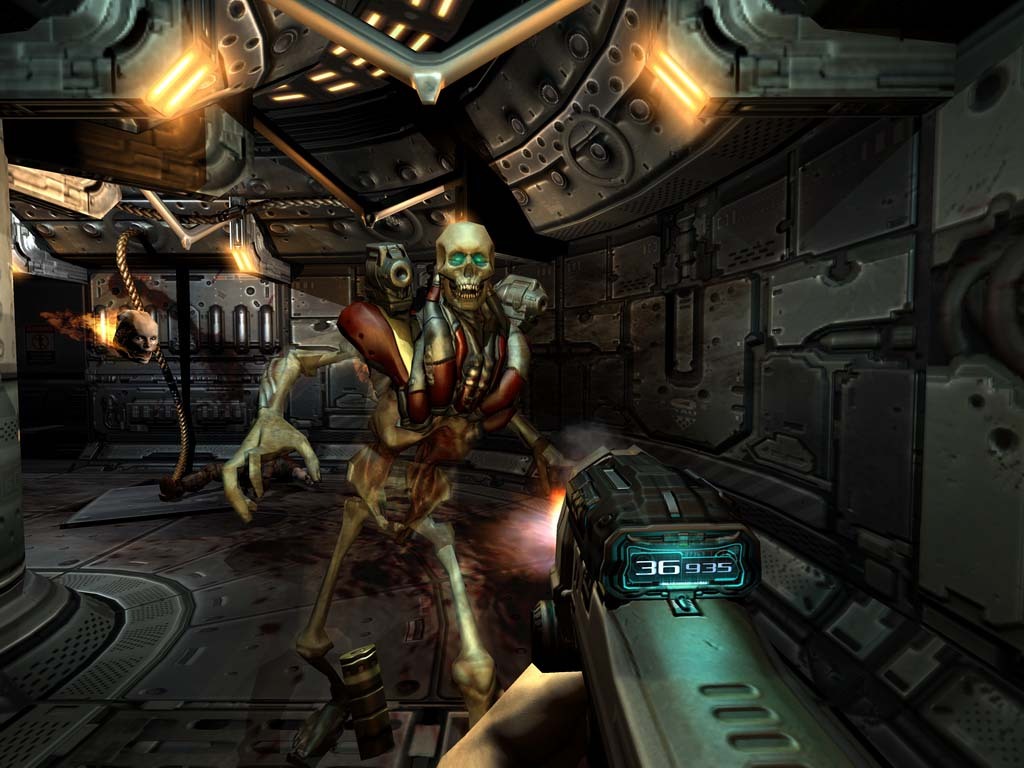 | |
| DOOM 3, screenshot stolen from STEAM |
Which brings us back to DOOM3. The game has low onscreen enemy count, a focus on horror and exploration of dark, maze like levels. Sounds a lot like the original DOOM and Quake, right?
However, in 2004 games were running on much more powerful hardware. Gamers had become used to seeing hordes of enemies on screen, like in Serious Sam, lots of action and extremely fast movement speeds, like in Quake 3.
I think when players talk about the "feel" of a Doom game, they refer to not the base game, but the mods of DOOM II. Mods like Brutal Doom and Project Brutality, which put hundreds if not thousands of enemies onscreen at a time, tons of blood and gore effects, multiple crazy weapons, and brutal killing moves and finishers. This is the style of gameplay that the reboot DOOM (2016) followed to near universal acclaim.
The last major complaint most players have of DOOM3 are the so-called "jump scares", or enemy ambushes that comprise almost every encounter in the game. Quake did this a lot as well, though no one seems to remember, where you would walk to a certain point and an invisible trigger would spawn monsters behind, above and around you. I didn't like it in Quake and I don't like it in DOOM3. DOOM and DOOM II, by virtue of technological limitations, did not use this technique, though they had plenty of "monster closets", rooms with hidden doors that would open and let out monsters once the players pulled the appropriate switch. I much prefer fixed enemy placements, and sadly DOOM3 had none.
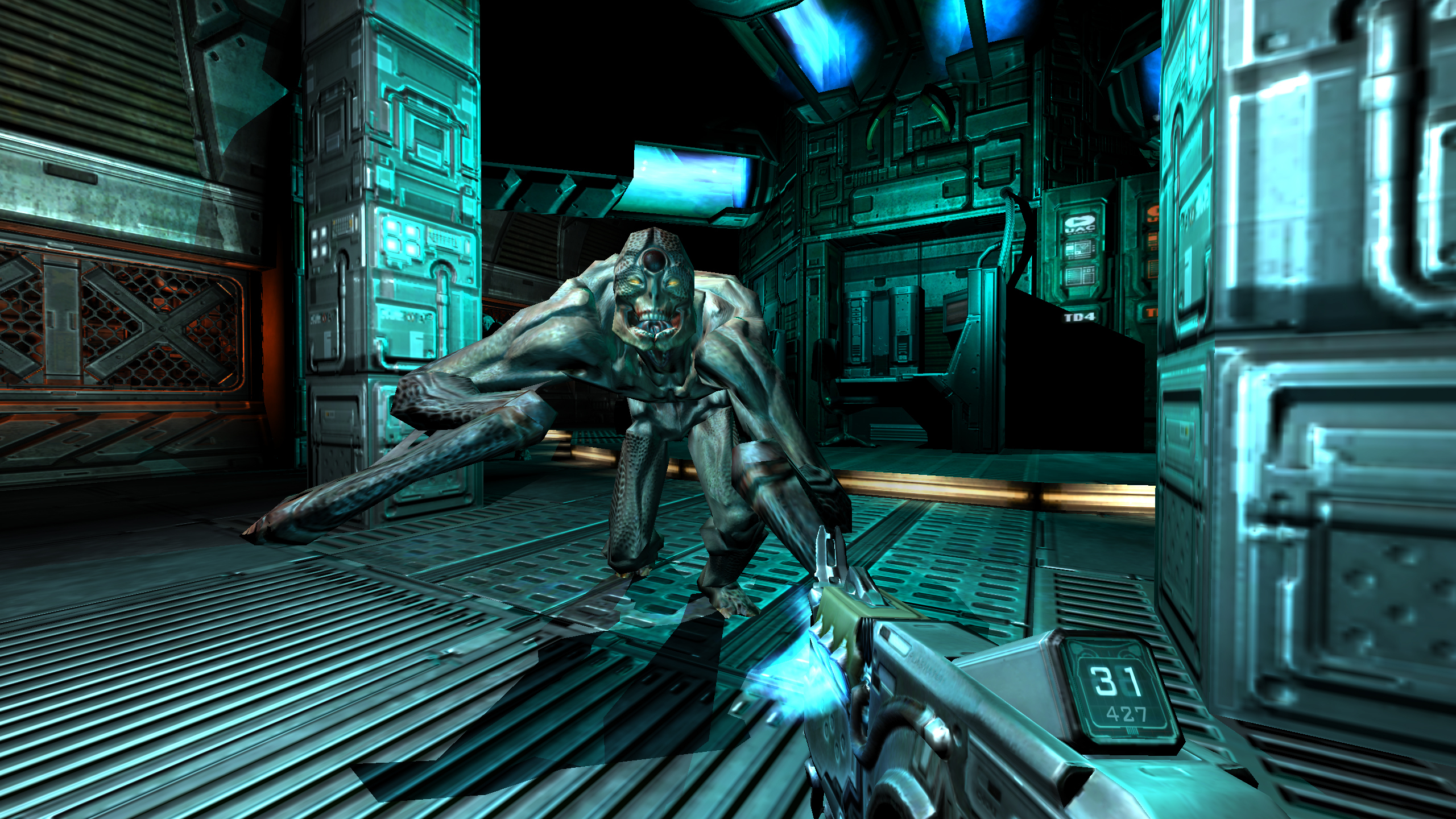 |
| Doom 3: BFG Edition, image stolen from GOG.com |
DOOM3 on its own merits is an amazing game. The gunplay is tight and responsive, the weapons are all unique and useful, the enemies while not smart are challenging due to their placement in the level, and with some tactical knowledge and forethought, are able to be overcome flawlessly. The level design of DOOM, DOOM II and Quake are God-tier, and while DOOM3 is not quite as good it is still far better than the standard corridor shooter FPS level design, or the static attack and defense lines of the Call of Duty series.
I have recently been on a marathon of shooter games, and focused on id software games since I never seriously played them while younger - I played maybe the first few levels of all of them, and that was it. It has been a refreshing and eye-opening experience, and judged from this perspective DOOM3 is very much like its predecessors and a very enjoyable game in its own right. It has some very tangible flaws and is not the perfect shooter, but is not a bad game by any means and was unfairly derided upon release. As FPS games go, you can do quite worse than DOOM 3.
Monday, March 19, 2018
Halo Is Casual Trash

When Halo: Combat Evolved first launched for the Xbox, I was fairly impressed that someone finally managed to translate standard FPS mechanics onto a console. Some people claim that GoldenEye 007 was the first console FPS success story, but GoldenEye had wonky controls due to the N64 controller and it's single analog stick, which made aiming difficult and circle strafing nearly impossible. The Xbox, with its two analog sticks, neatly avoided this problem. Shortly after Halo's release, every console FPS borrowed its control scheme.
However, by being on a console, compromises had to be made. I do not fault Bungie for making concessions to have Halo run and play well on the Xbox. After all, they managed to basically take the mechanics of Quake and mapped them to underpowered hardware that uses a gamepad. As a result, the game speed had to be slowed down, the players moved slower, the jumps floated in air a bit longer, the weapons were easier to handle. Halo: CE is basically dumbed down Quake.
What I do fault the developers at Bungie for is the intentional game design that made Halo easier, safer, and less technical to play. A core principle of Halo's design is that children, aged 12 and up, should be able to pick up the game and play at a decently competent level, without feeling that the game was 'too hard' or that multiplayer was 'unfair'. By raising the skill floor of Halo, the consequence was that the skill ceiling got lowered at well. If you were amazing at highly competitive shooters like Unreal Tournament and Quake 3, then Halo would seem too simple, shallow and slow.

I will now enumerate everything that makes Halo a shallower, more casual experience than its "arena shooter" predecessors. Remember that Halo was intentionally designed to be similar to older shooters, but easier for a new audience of gamers.
Shields over health: Shields exist only to make it impossible for a victim to die in a single burst of fire. The attacker must first break his target's shields before he can do any real damage. Armor has been a concept in FPS games since DOOM, but in DOOM they only mitigated damage taken to your health, in Halo your shields are effectively a second health bar.
Passive Shield Regeneration: Means that now there is no consequence for taking a large amount of fire, because you can recover your full shield bar by just waiting around for a bit. Instead of incentivizing the player to run into battle, it actually does the exact opposite. On easier difficulties this means you have no real challenge and no need to play with forethought, and on Legendary difficulty this becomes a real problem as the only way to really make it past most waves of enemies is to pop out of cover, take as much damage as you can while killing one or two enemies, then ducking back into cover to regenerate your shield. This is especially frustrating against higher tier enemies, since on Legendary they will have double or triple your amount of shield, so fighting against them becomes a war of attrition while your struggle to deplete their shields before you can go in for the kill. This is what made the "noob combo" such an overused tactic, more on that later.

Weapon Reloading: You may argue that reloading a weapon is more "realistic", but the Halo game universe is one in which mankind has mastered faster than light travel, has ships that can travel between solar systems, and super soldiers that can live inside a suit of powered armor indefinitely. Star Wars has interplanetary travel, and no one needed to reload their blasters. Star Trek has the same, and no one needed to reload a phaser. You may note that the Covenant weapons, which don't need to reload, still overheat. Reloading and Overheating exist for one primary purpose - to delay an attacker from killing an opponent and to force them into an artificially vulnerable state. In effect, it slows down combat.
Against shielded opponents, you cannot kill them in a single magazine, and must reload or switch weapons in order to press your attack. Many weapons are designed around this concept and the metagame is designed around you choosing two different weapons to kill an opponent. Which leads into the next problem
Two Weapon Limit: DOOM allowed you to carry 7 weapons at a time, Quake 3 went up to 13. Halo lets you carry only two, due basically to the limitations of the gamepad, but also to restrict your options in an engagement, and to discourage you from simply switching weapons to keep killing your foes. By forcing you to carry two weapons at a time, you are pigeonholed into a certain strategy for facing your foes.
In single player this is far more frustrating than in multiplayer, since you will be carrying the weapons with the most utility most of the time, and powerful, specialized weapons become a hindrance, especially if you want to conserve their ammo for use on the more powerful enemies. You will be fighting weak, low tier enemies more often that the higher tier Elites or Brutes, but when the high tier Elites or Brutes do show up you find yourself without a good power weapon to counter them. The low tier enemies carry only pistols and other weak weapons, and the power weapons are carried only by the power enemies, so when you kill them and take their weapon, you suddenly find yourself with a power weapon but no one to use it on, but hordes of weak grunts that will waste your ammo until you run out and run into another strong enemy with a power weapon. That's just bad game design.
In multiplayer its just an artificial, cheap way to force you to stop chasing enemies, and to retreat into cover to reload and exchange weapons in order to face the next encounter. This also means that against multiple opponents, your chances of survival are lessened since you will simply run out of bullets before you can kill more than 2 foes.

And now the "noob combo." High shield enemies with powerful weapons are no fun to fight against if you don't have an appropriately powerful weapon. Luckily, the developers at Bungie gave players an easy counter in the form of the humble plasma pistol - the charged up shot can completely disable a target's shields and leave them vulnerable for any secondary weapon to finish this off. Using a moderately high damage weapon like the magnum pistol, or DMR/Battle Rifle in Halo 2 and beyond, made this a ridiculously effective strategy. Its usefulness carried over into multiplayer as well, and is derided by many players. And its easy to see why, it shortcuts the balance of the game and lets you use two simple, common weapons to outdo some of the most powerful ones. And yet if this option was not in the game, then the metagame balance would be constantly skewed towards however holds the more powerful weapon, which is why the "noob combo" persists in every Halo game. It must exist because the entire franchise's game design is fundamentally flawed.

Halo did manage to do a lot of things right. It was a technical marvel on the Xbox, it had a rich, intriguing science fiction world, the music was top-tier, the characters believable, enjoyable and fleshed out. However the moment-to-moment gameplay, the "30 second loop" of combat falls short of its peers, other FPS games that were out on PC at the same time. Unfortunately it spawned a generation of children that believe that Halo was the best shooter ever, and its wild popularity caused every subsequent FPS to ape the Halo mechanics of regenerating health and two weapon combat. Even before Call of Duty 4, Halo: Combat Evolved had such an impact that it managed to casualize the whole First Person Shooter genre.
It's still enjoyable in mild doses, but the same can't be said about its sequels. There's nothing good about Halo 2.
Subscribe to:
Posts (Atom)